Robert Kiyosaki’s #1 Rule For Never Being Broke Again
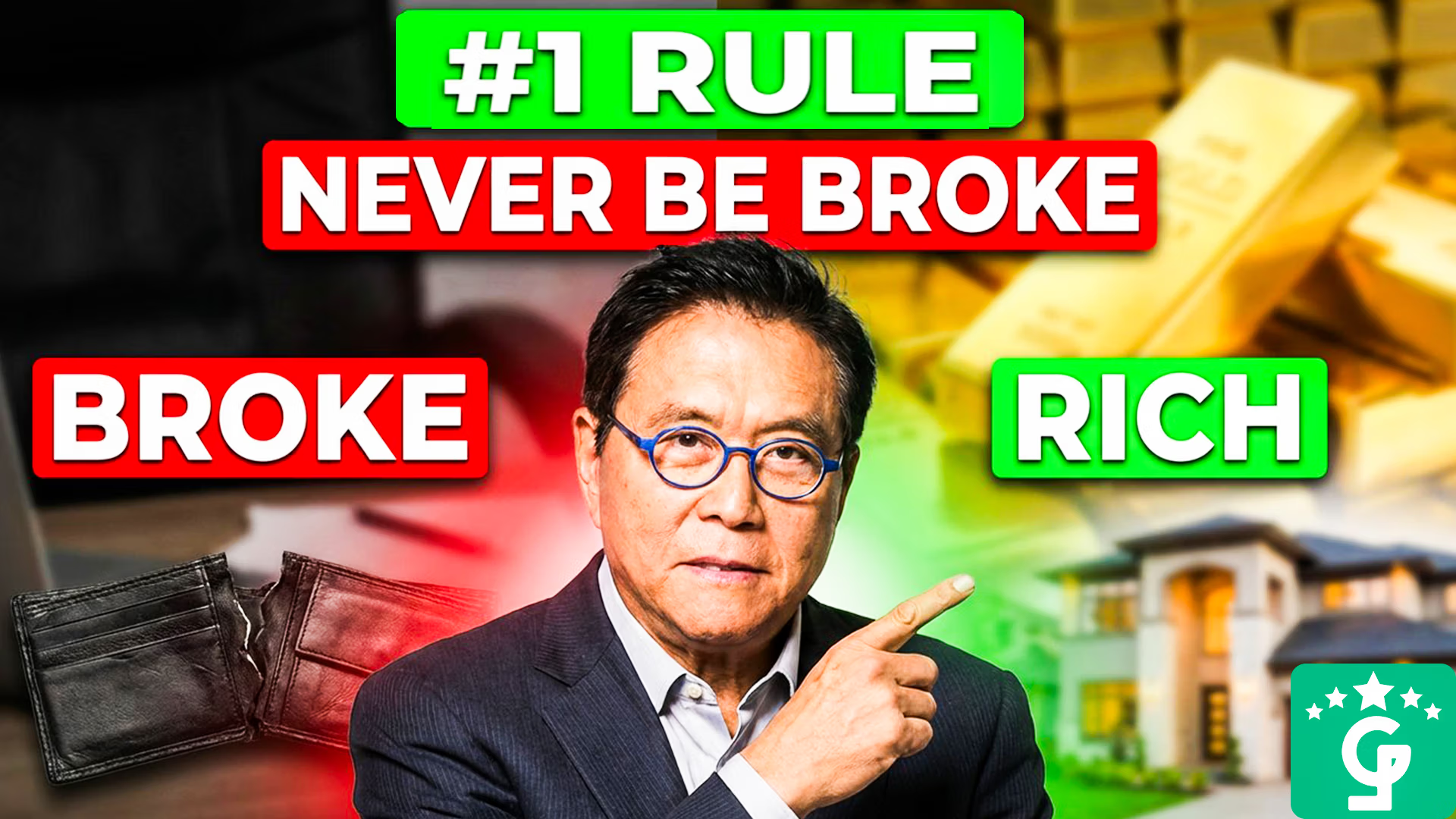
Rich Dad Poor Dad author Robert Kiyosaki reveals his number one secret rule for never being broke ever again.
Not only that: Other successful millionaires and even billionaires like Grant Cardone, Tony Robbins, and Dave Ramsey share their most important tactics for never being broke.
Starting with Kiyosaki’s own words. He owns about 12,000 rental units, but he says, “That’s not even the story. The real story is how he acquired those properties: he uses debt, and that’s what they don’t teach you in school”. In his words, “the more property I own, the less tax I pay.”
▶ Watch the full clip · Credit: DJ Vlad, Robert Kiyosaki interview, 2023
The more debt Kiyosaki uses to buy property, the less tax he pays. That’s what the next section covers in detail.
Welcome back to Genie Finance. If you’re new here, subscribe to our YouTube channel, because we’re about to hand you the exact playbook these four self-made millionaires used to build wealth and never be broke again.
RULE N°1: The Debt Rule That Decides How Fast You Build Wealth
Debt isn’t good or bad. It’s a tool. What matters is what it’s pointed at.
This choice can determine how fast you build wealth. Robert Kiyosaki and Grant Cardone champion “good debt”: borrowing to acquire cash-flowing assets. That’s good debt.
Here, Kiyosaki explains why he talks about debt so much: “In 1971, Nixon took the dollar off the gold standard, and money became debt.” He says, “Live debt-free is good advice for the average person, because debt will kill you.” But debt is money today, so when he acquires an asset, he uses debt. His example: he earns $1 million in book sales, he borrows $10 million, and buys properties. That’s “the magic called financing,” and he says he pays no taxes.
▶ Watch the full clip · Credit: DJ Vlad, Robert Kiyosaki interview, 2023
He uses income from book sales to qualify for debt, then uses that debt to buy property. The write-offs on that new property (appreciation, depreciation, amortization) shrink what the IRS sees as taxable income.
You don’t need $10 million to use this concept. You need to understand the shape of it first.
Here’s the math. A $40k down payment may sound like a stretch right now, so hold that thought:
- Purchase: a $200k duplex
- Rental income: $2,200 per month (for both units)
- Mortgage: $1,100 per month
- Insurance, taxes, maintenance: $600 per month
- Net cash flow to your pocket: $500 per month, or $6,000 a year
While someone else pays off your loan and the property gains value.
Pause here for a second and do the same math on your own numbers. Could you cover a $1,700 per month payment for a shot at $500 per month coming back? That’s the actual question good debt is asking you.
On investment properties, mortgage interest is a business expense, slashing your tax bill while the property grows in value.
Your credit card charging you 24% to buy groceries? That’s bad debt destroying you.
Dave Ramsey says the opposite: all debt is bad.
Before you roll your eyes at the boomer-debt-guy, know that Ramsey’s path is the one that actually matches where most people reading this are right now. If you’re in debt, what Ramsey says here might matter more than anything you’ve read so far.
Ramsey calls it the debt snowball, or Baby Step Two.
“List your debts from smallest to largest and pay minimums on everything except the smallest one. Attack that one with a vengeance. When it’s gone, roll that money onto the next one, and keep going. Every time the snowball rolls over, it picks up more snow.” He’s taught millions of people to do this, and it works. Someone objects that “it isn’t mathematically correct and you should pay the highest interest rate first”; his answer is: “If we were doing math, we wouldn’t have credit card debt.”
▶ Watch the full clip · Credit: The Ramsey Show Highlights, Dave Ramsey, 2025
His debt snowball method attacks debts systematically. Say you have five debts:
- $800 medical bill
- $2,100 Best Buy card
- $4,300 car loan
- $8,200 Visa
- $43,000 student loans
Attack the $800 medical bill first. Pay minimums on everything else. Throw every spare dollar at that medical bill. Two months later, it’s gone. Now take that $400 per month you were paying and add it to the Best Buy card payment. Four months later, that’s gone too.
The wins stack. The momentum builds. You start believing you can actually do it.
If you’re drowning in credit card debt right now, leveraging more debt to buy real estate will crush you. Start with Ramsey’s path first and get the bleeding to stop. But if you’re debt-free and sitting on savings, Kiyosaki’s leverage might 10x your wealth-building timeline.
Know where you actually are. Then pick the path that fits you best.
RULE N°2: The One Test That Exposes What Is Making You Poor
Kiyosaki’s foundational rule: an asset puts cash in your pocket; a liability takes it out.
He says, “One reason so many people struggle financially is that they call their liabilities assets.” His rich dad taught him that assets cash-flow money into your pocket, and a liability takes money from it. “For most people, a house is a liability: every month it takes money to live in it.” Even a paid-off house still costs you insurance, upkeep, and maintenance.
▶ Watch the full clip · Credit: The Rich Dad Channel, Robert Kiyosaki
If it doesn’t put money in your pocket, it’s a liability in disguise.
Your parents may have told you that buying a house was “building wealth.” They lied. Not on purpose. They just didn’t know.
A $400k house costs you:
- Mortgage: $2,800 per month
- Taxes: $600 per month
- Insurance: $200 per month
- Plus maintenance, like when the water heater dies at 11 pm
That’s $3,600+ flowing out of your pocket every month. It’s not making you money. It’s a place to live.
Kiyosaki calls it a liability disguised as the American Dream. Unless you’re renting out rooms and cash-flowing more money, it’s keeping you broke!
The rich operate in the B and I quadrants: Business owner and Investor. They acquire assets that work without their constant presence.
You’re probably in E right now: Employee, trading 40 hours for a paycheck. Maybe you’re building a side hustle. That’s S: Self-employed. You stop working Friday, you stop getting paid Friday.
Both cap your income at your working hours. That’s the actual ceiling on the 9-5.
B and I are different:
- “Business owner” means you built a system that runs without you.
- “Investor” means your money makes money even while you sleep.
The goal is getting out of E and S.
Assets compound over time while liabilities drain you. The difference between the two determines your wealth trajectory more than your salary ever will.
Does it put money in your pocket? That’s the test.
- A YouTube channel earning $600 per month → Asset
- A $45k Tesla financed at $780 per month → Liability
- A course that can earn you $150 per hour → Asset
- A $2,000 gaming PC → Liability
Warren Buffett put the whole liability trap in this one line: “If you buy things you do not need, soon you will have to sell things you need.” The Tesla and the gaming PC are exactly what he’s talking about.
Run every purchase through this test.
Drop your biggest “liability in disguise” in the comments. We’ll read through and reply to the ones that hit hardest.
RULE N°3: The Income Shift That Changes Your Tax Game
Kiyosaki breaks income into three types: earned, portfolio, and passive income.
- Earned income is what you get when you “go to school and get a safe, secure job.” He calls it the most highly taxed of all, “at least 50% for most people in the US.”
- Portfolio income (capital gains) sits at about 20%.
- Passive income, if you’re smart and know what you’re doing, can be brought down to 0%, legally. He stresses the word « legally ».
His conclusion: since tax is your highest expense, why not work hard for passive income?
▶ Watch the full clip · Credit: The Rich Dad Channel, Robert Kiyosaki
Taxes are most people’s single largest lifetime expense. When you work for money (employee), the government takes the first and biggest slice. Employment taxes plus income taxes hit self-employed workers hardest.
Billionaires structure their wealth to pay nearly zero tax legally, leveraging the same code that rewards investors over workers by design.
Here’s the part most finance content skips: banks create every dollar in your account as debt. The Fed doesn’t print money and hand it out to banks. Banks create it by lending. When you borrow $200k for a rental property, the bank literally creates new money. And the government gives you tax breaks for doing it.
Mortgage interest? Deductible. Property depreciation? Deductible. They’re paying you to borrow money. But only if you’re using debt for assets, not liabilities.
Credit card debt to buy an iPhone? No tax breaks. Mortgage debt to buy a duplex? Tax shelter.
Say, you made $48,000 last year at your 9-5:
- Federal took: $5,200
- State took: $2,100
- Social Security took: $3,600
- Your take-home: $37,000, with 23% gone before you even touched it
Meanwhile, Jeff Bezos sold $10 billion in Amazon stock and paid 20% long-term capital gains. You pay a higher tax rate on your $48k than billionaires pay on their billions.
Bezos still pays a massive number in dollars. The gap is in the rate applied to each kind of income, and that rate gap is exactly what this section is about closing for you.
By learning the same rules that billionaires use:
- Earned income (from your job or active work) is taxed at the highest rate.
- Portfolio income (capital gains from selling stocks) is moderately taxed.
- Passive income (from assets like rental properties) is taxed most favorably, with massive tax deductions available.
The same $48,000, but this time from a rental property?
- Depreciation write-off: $18,000
- Mortgage interest deductions: $11,000
- Property management fees, repairs, utilities: $8,000
Your taxable income on paper, after all deductions? $11,000. You made 48k but the IRS only taxes you on 11k. That’s $1,300 in federal tax instead of $5,200. You just saved $3,900 by understanding the tax code.
If that number just made something click, smash the like button on our YouTube video. It helps more people actually see and understand this.
Debt and taxes make the rich richer but crush poor people who don’t understand the rules.
Shift your income from earned to passive, and debt and taxes stop being the thing keeping you broke. They become the tools that make you wealthy.
RULE N°4: The Money Split Rich People Protect
Grant Cardone’s 40% Rule
Picture 100% of your money. Cardone points out that “40% goes to the IRS,” and he jokes that everyone agrees on how they feel about them. His point: “If you’ll pay them 40%, you should at least pay you 40%.” Everyone in the room, he says, has already figured out how to pay these people.
▶ Watch the full clip · Credit: Grant Cardone
Let’s run the numbers:
- Average John’s income: $4,000 per month
- Taxes: $920
- Left after taxes: $3,080
- Cardone’s rule says invest: $1,600
- Live on: $1,480
Run your own numbers for ten seconds: rent, food, one bill. Does 40% invested even survive your real budget? If the honest answer is no, you’re not failing the rule. You’re finding out you need to earn more before you can follow it, and that’s exactly what this next section is really about.
Most people can’t follow the 40% rule straight out of the gate. They either need to earn more or cut expenses a lot more.
Your allocation system determines whether money works for you or evaporates into consumption.
Now, Tony Robbins discovered something wild: you can know every investing strategy, every tax strategy, every wealth-building habit, and still be broke. Because knowing isn’t doing.
Robbins puts it as “80% is psychology, 20% is mechanics.” He’s a strategist, “and the right strategy can save you a decade. But without the right psychology, you’ll learn the strategy and you won’t apply it.” Psychology, he says, “is the driving force behind an extraordinary business and an extraordinary life.”
▶ Watch the full clip · Credit: Tony Robbins, Money: Master the Game
The 20% is mechanics: buy assets, use good debt, minimize taxes. The 80% is psychology: actually doing it.
When your friends are buying bottles at the club, you’re buying dividend stocks. Saying no to the $60k car lease when you make $50k a year. Investing $500 every month for years… even when Netflix just raised prices and you want to quit.
Financial freedom isn’t about having more money. It’s controlling your money and your life completely.
You need both. The systems and the mindset.
If the mechanics make sense but the mindset part feels like the hard part, that’s what the Genie community is actually for. Not just more information. Accountability for using the information you already have. Join from this link:
Join the Genie community (free) → geniefinanceapp.com/subscribe.
Bottom Line
We just revealed Robert Kiyosaki’s #1 rule for never being broke again.
Not only that, we revealed some of the world’s most successful millionaires’ and billionaires’ most important tactics. So you too can never be broke again.
These four rules have built more fortunes than any other strategy:
- Assets: the foundation
- Allocation: the structure
- Tax strategy: the amplifier
- Debt: your accelerator (or brake)
The gap between knowing and doing? That’s on you now.
But you’re ahead. Way ahead of most people.
The rich just know the rules most people weren’t taught. Now you do too.
If this article gave you something real, subscribe to Genie Finance. We’re here to help you build massive wealth. Drop a comment if you’re stuck at any point.
And tell us which of these four men matches where you’re at right now on your wealth-building journey: Kiyosaki, Cardone, Ramsey, or Robbins.
Don’t miss the next episode.
We’re revealing something 99% of people don’t know money can buy.
And it’s not a stock. A coin. Or a business.
Genie Finance: The Guide To Future Success; Far From Conventional.